
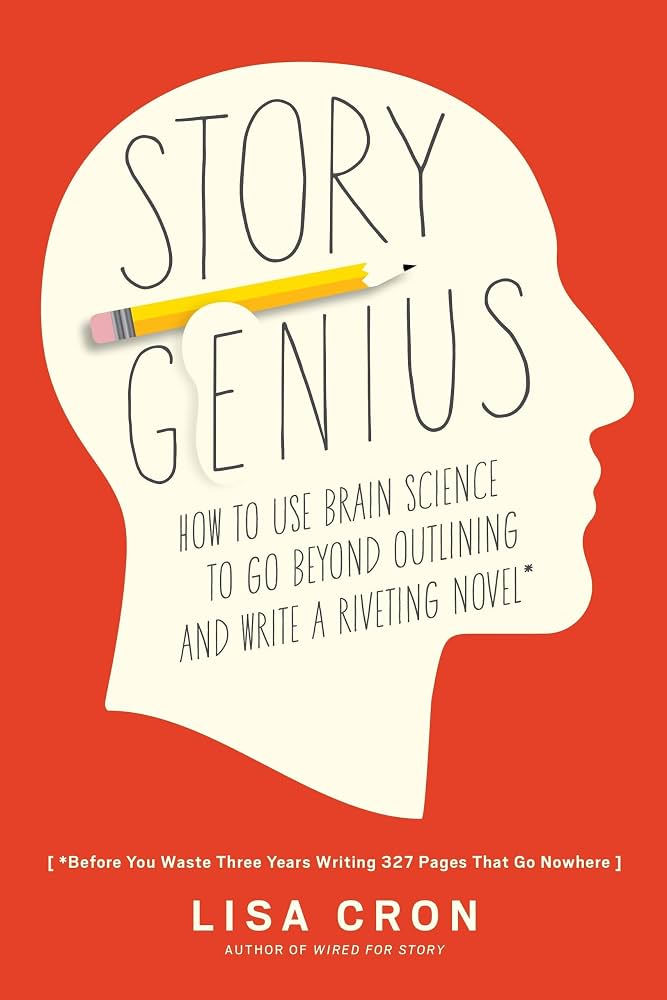
Before we talk about Story Genius, I have an honest confession to make – I’m actually not much of a fan of writing craft books.
Well, it shouldn’t come as a surprise to you, considering that many of the books that I’ve recommended on this blog were mainly personal development and business books.
Writing craft books?
Not so much.
People always say that if you want to write a page-turning book, you need to learn about the writing craft.
Not going to lie, it’s not wrong advice.
But reading tons of writing craft books won’t help you improve your writing if you don’t know what it is that you lack.
It’s even worse when those mega best-selling authors are giving you polarizing advice.
Thankfully, I only read a handful of them, and they’re based on what I’m struggling with.
But this book somehow made it to my recommendations simply because it’s a writing book that emphasizes a lot of the story structure.
Okay, I get that having a story structure sounds stiff to you.
But trust me, you don’t want to sleep on this one if your goal is to write a page-turning book that spreads like wildfire.
And that can also mean ka-ching to you.
Who doesn’t want that, right?
What Story Genius is all about
Here’s the book description that I got from Amazon.
Following on the heels of Lisa Cron’s breakout first book, Wired for Story, this writing guide reveals how to use cognitive storytelling strategies to build a scene-by-scene blueprint for a riveting story.
It’s every novelist’s greatest fear: pouring their blood, sweat, and tears into writing hundreds of pages only to realize that their story has no sense of urgency, no internal logic, and so is a page one rewrite.
The prevailing wisdom in the writing community is that there are just two ways around this problem: pantsing (winging it) and plotting (focusing on the external plot). Story coach Lisa Cron has spent her career discovering why these methods don’t work and coming up with a powerful alternative, based on the science behind what our brains are wired to crave in every story we read (and it’s not what you think).
In Story Genius Cron takes you, step-by-step, through the creation of a novel from the first glimmer of an idea, to a complete multilayered blueprint—including fully realized scenes—that evolves into a first draft with the authority, richness, and command of a riveting sixth or seventh draft.
What got me to read the book
Okay, I won’t deny that I got the book when it was on sale on Amazon.
But what got me to get this book has more to do with me, who was already familiar with her previous work, Wired for the Story.
In case you’re wondering, I didn’t get the Wired for the Story book.
I actually enrolled in her Wired for the Story course at CreativeLive, which I got for free during NaNoWriMo.
Will I still get the book if I wasn’t familiar with her previous book and the book wasn’t even on sale?
Believe it or not, the answer is yes.
Strangely enough, the Kindle version is a little pricier than the paperback version.
I’m not sure how the math works here, but I’m thinking about getting the paperback version as well, since this is another book that is best in physical copy.
What makes Story Genius worth reading
When you think about a book you can’t seem to put down, you probably think the reason it’s addictive has something to do with how talented the writer is.
Well, you’re not wrong about that.
Talent does have a role in writing a page-turner.
But it turns out it has more to do with how our brain processes story, even the fictional ones.
Pretty much every single page-turner out there has similar patterns.
So, what does it mean for all of us out there?
It means that you can create the same page-turning book with the science-backed framework.
The good news is that you don’t have to figure it out on your own since Lisa already cracked the code for you.
Before you get to the juicy part, you need to know what makes the story such a page-turner, which is what the first few chapters in the book are all about.
And the next part of the book is all the juicy part we’ve been dying to know about, which is the structure for a page-turning story.
Here’s what I find fascinating about the framework outlined in this book – the example provided in the book makes me interested in the story.
And it’s not even in the genre I usually read either!
So, what does it mean for all of us?
It means that this framework can turn any kind of story into a page-turner, enough to attract those who don’t read in that genre.
Now, I can’t say for sure if the framework will have the same magic on your book.
But it’s clear that you can replicate the same effect for your book when you have the right framework in place.
That page-turning book that you’ve been raving about is certainly not reserved for those with big talent.
What you should know about this book
Just like any other nonfiction books out there, you need to do the book.
You can’t just engage with the book passively, thinking that will be enough.
Sure, you can just leave all the story concepts and character arcs in your head.
But it’s only when you put your ideas on paper that you start to gain clarity on your story.
If it sounds like outlining and it’s boring as hell to you, it sure is on the surface.
But hey, it’s worth spending your time doing all the exercises if it can help you gain clarity on your story.
And when you are clear about the story and characters, it makes writing the first draft and editing a lot more seamless, too.
Another thing to note about the book is that you may find some of the exercises are a little tricky to do when you write a plot-driven story, as I do.
Does it mean that the framework outlined in this book is useless if you don’t write a character-driven story?
Of course, the answer is no.
Rather than saying those exercises are irrelevant to you, perhaps you can use the same exercises to understand your character instead.
See, there’s a workaround for that.
It also makes writing a plot-driven story so much better now that you understand your characters inside out.
Who should read this book?
Well, obviously you need to read this book if you write fiction in any genre.
But this same framework will also work for you if you write creative nonfiction.
If you’re looking for a different way of outlining, this book is perfect for you, too, especially when the framework is backed by science.
We all love scientific stuff, don’t we?
If you write the typical nonfiction, obviously this book won’t do much for you.
Instead, I highly recommend that you read Your Story Advantage: A Proven Path to Maximize Your Impact, Influence & Income by Bill Blankschaen.
Just like Story Genius, it provides a framework that you can follow to write nonfiction.
I like the framework in this book since it’s the framework that many nonfiction books use, where the chapter tends to begin with a story.
Where to buy the book
You can buy the book wherever books are sold.
But if you prefer to get it on Amazon, you can get it right here. That’s where I got my copy from, in case you’re wondering.
Buy Story Genius book by Lisa Cron on Amazon
Over to you
What do you think about Story Genius by Lisa Cron? Are you interested in giving it a try after reading about it on my blog?
Let me know in the comments.